
Add to pdf basket
©MicroOne | source: AdobeStock #279974268
The science of nanofluidics has the potential to revolutionise everything from water purification to computing. The EU-funded SHADOKS project set out to increase our understanding of nanofluidics, and use this new-found knowledge to build game-changing applications. The results of this work will lead to groundbreaking innovation in the years to come.
Add to pdf basket
©René Notenbomer #491287131 source: stock.adobe.com 2023
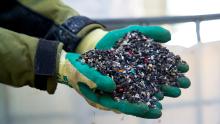
Composite materials are widely used across multiple industries, yet are difficult to recycle. The EU-funded FiberEUse project developed new solutions to reuse composites and recover their residual properties. The developments could make these structural materials more cost-effective and environmentally friendly.
Add to pdf basket
©elena #464433613 source: stock.adobe.com 2023
Ovarian cancer is often diagnosed too late for treatments to work. The EU-funded EARLYDETECT project developed innovative screening tools capable of detecting the disease early. This will help patients receive the therapies they need sooner, before the disease spreads, saving the lives of citizens in the EU and beyond.
Add to pdf basket
© utah51 #365765671, source: stock.adobe.com 2021
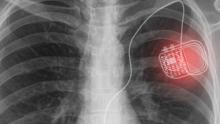
Materials used in medical implants such as pacemakers and insulin pumps can be hazardous to the body. The EU-funded BISON project seeks an alternative in self-assembling peptide building blocks. These biological electronics offer citizens safer implants that could be powered by the body itself.
Add to pdf basket
© Production Perig, #192822957, source:stock.adobe.com 2020
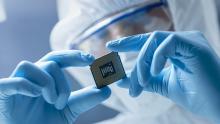
Cutting-edge photolithography technology developed by an EU-funded consortium has enabled the launch of a new generation of high-performance smartphones featuring powerful and efficient 7nm-node mobile processors.
Add to pdf basket
© Helio Display Materials Ltd., 2019
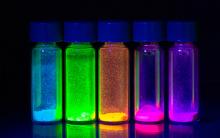
EU-funded researchers behind a breakthrough solar-energy technology have also laid the material foundations for a new generation of digital displays that could surpass latest-generation OLED screens in brightness, colour range and energy efficiency.
Add to pdf basket
© PRUSSIA ART, #278535975 source:stock.adobe.com 2020
Industrial applications often call for surfaces designed to attract or repel water. EU-funded researchers are devising new methods to characterise and manufacture such surfaces and will make their findings public in a new Open Innovation Environment.
Add to pdf basket
© IPN, 2019
Around 40% of EU energy consumption and 36% of its CO2 emissions come from buildings. EU-funded researchers have developed easy-to-install eco-panels to place on the outside of the buildings to dramatically cut both.
Add to pdf basket
© Gorodenkoff #165717610, source:stock.adobe.com 2020
An EU-funded project is enabling efficient intra-chip and chip-to-chip communication via a new type of silicon capable of emitting light. It is demonstrating a technological breakthrough that could revolutionise the electronics industry and make devices faster and much more energy efficient.
Add to pdf basket
© andranik123 #289020801, source:stock.adobe.com 2020
A team of EU-funded researchers has developed an accurate and non-invasive way to detect cancer through a person's breath. The hand-held sensor can be used by anyone without medical supervision in combination with their smart phone. Tests reveal the accuracy of the sensor is about 93 %.