Add to pdf basket
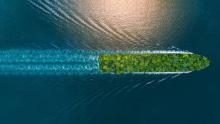
©Yellow Boat #1006130163 | source: stock.adobe.com
The shipping industry produces more than 1 billion tonnes of carbon dioxide each year, accounting for nearly 3 % of human-caused global emissions. By converting ships to run on renewable liquid fuels, the EU-funded FASTWATER project is showing how transport emissions can be cut, offering significant progress towards the EU’s climate goals.
Add to pdf basket
© European Union 2024
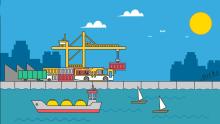
Inside Europe’s bustling seaports lies a wealth of untapped data. Despite digitalisation, much of this information still goes unused. The EU-funded DataPorts project is an initiative focused on leveraging Europe’s maritime data to revolutionise port operations and enhance efficiency.
Add to pdf basket
©AkuAku # 653763944 source: stock.adobe.com 2023
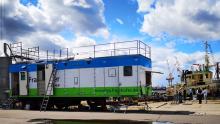
The shipping industry is responsible for 3% of global carbon emissions, putting it under the spotlight for environmental upgrades. Two game-changing vessel designs have now been produced with the help of EU funding, along with retrofit technologies for existing cruise ships and bulk carriers. Maritime sustainability is a key EU priority on the continent’s journey to slashing carbon emissions while creating opportunities for green economic growth and jobs.
Add to pdf basket
© Okea #45901459, source: stock.adobe.com 2021
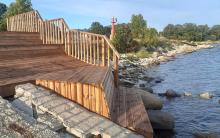
The diesel ferries used to transport people and vehicles from point A to point B produce a lot of air pollution. But a new all-electric, pollution-free car ferry designed by the EU-funded E-ferry project has proven capable of effectively replacing these diesel models. As a result, passengers across Europe could soon be commuting via sustainable, quiet, and smog-free electric ferries.
Add to pdf basket
©silvae #226756262 source: stock.adobe.com 2021
Methanol has been touted as a potential climate-friendly ‘fuel of the future’ since the late 1980s, but its use in the transport sector remains limited. The possibility of generating it from CO2 has recently rekindled interest. An EU-funded project explored this option to decarbonise the steel industry and power cargo ships that would benefit both the environment and, subsequently, citizens.
Add to pdf basket
© CoreDESIGN #277710798, source:stock.adobe.com 2020
A huge EU-funded project has demonstrated how big data and artificial intelligence could transform Europe's transport sector, cutting costs and fuel consumption on road, rail, air and sea while boosting operational efficiency and improving customer experience.
Add to pdf basket
© Maurizio Vretenar, 2019
EU-funded researchers have developed innovative particle accelerator technology capable of removing harmful sulphur and nitrogen oxide emissions from ship exhaust in a breakthrough that will support the transition to a greener, less-polluting and more sustainable global shipping industry.
Add to pdf basket
© Harri Reimand, 2019
How do you feel after a day at the beach? Energised, centred, relaxed? You are not the only one - it seems that any body of water can potentially boost people's well-being. EU-funded researchers are studying the health benefits of blue infrastructure to help planners make informed decisions.
Add to pdf basket
© Nightman1965 #89893326, 2019 source: stock.adobe.com
Seas have long been invaluable resources for EU countries. But those same seas can be conduits for piracy, drug trafficking and irregular migration. A group of security specialists has launched an EU-funded project to better integrate sources of maritime intelligence. The result will be safer seas for all who sail them.
Add to pdf basket
© Sychugina Elena #59958005, 2019 source: stock.adobe.com
Critical infrastructure, like ports, face growing threats - both physical and cybernetic. In response, EU-funded researchers have developed novel 'hybrid' situation-awareness tools, including visualisation techniques for detecting, preventing, and mitigating the impacts of potential attacks.