Health & environment

Add to pdf basket
©New Africa #217627537 | source: stock.adobe.com
The EU-funded MycoTWIN project took on one of agriculture’s toughest challenges: fungal compounds that contaminate food supplies, especially cereals, nuts and dried fruits. The project brought together researchers from Italy’s National Research Council (CNR-ISPA) and Spain’s University of Valencia (UV) to enhance research capabilities in Türkiye. The result is improved food safety in Europe and beyond.
Add to pdf basket
©TTh  #968469849 | source: stock.adobe.com
Half of the world’s population lives in cities, and this figure is growing. Delivering water and sewage services in urban areas continues to be a significant challenge, especially in the face of climate change. Digital tools developed by the EU-funded DWC project are already being used to maintain Europe’s commitment to high-quality water infrastructure.
Add to pdf basket
©TensorSpark #703371085 | source: stock.adobe.com
By 2050, the global population will soar to 9 billion, with three quarters of this number living in urban areas. Pressure on ecosystems due to population growth, urbanisation and climate change will reach its peak. The EU-funded project ECORISK2050 set out to tackle the daunting task of future environmental risk management of chemicals in the face of global climate change.
Add to pdf basket
©Anna Schlosser #653156909 source: stock.adobe.com 2023
Microbiomes may have the potential to benefit the global food system, but tapping that potential requires coordinated research – which currently isn’t the case. The EU-funded MicrobiomeSupport project aims to change this by mapping the research landscape and highlighting the need to standardise data. In doing so, it is ensuring that microbiome research can support safe, healthy and sustainable food systems.
Add to pdf basket
©Angelina Bambina #329031868 source: stock.adobe.com 2023
It was assumed that viruses spread as independent particles called virions. The EU-funded Vis-a-Vis project used social evolution concepts to study viral transmission, showing how viral particles compete and collaborate with one another. An improved understanding of virus-virus interactions paves the way for a new generation of treatments.
Add to pdf basket
© STABVIDA, 2022
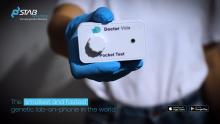
While researchers were busy developing a handheld device to rapidly detect biomarkers to guide the therapy in lung cancer, the pandemic struck. Realising their device could be adapted to test for coronavirus, researchers refocused their work. The result is the market’s smallest portable PCR device.
Add to pdf basket
© Romolo Tavani #329453915, source: stock.adobe.com 2021
Humanity is realising that the state of our oceans has a direct impact on our wellbeing. To identify key priorities in the field of oceans and human health, the EU-funded SOPHIE project created a network of diverse experts. By changing harmful behaviours and encouraging sustainable practices, they hope to contribute to better health for both the oceans and citizens across Europe and beyond.
Add to pdf basket
© maxsim #177951197, source:stock.adobe.com 2020
An EU-funded project has pioneered new techniques to detect and share information about infectious disease outbreaks. These methods will be used in the future to improve public health responses to pandemics. Already, some of the tools devised in the project are being further developed to specifically tackle the spread of COVID-19.
Add to pdf basket
© willyam #297885268, source:stock.adobe.com 2020
Crowded cities aren't exactly optimal environments for plants to thrive. However, a team of EU-funded researchers is using robotics to help plants automatically grow into the unnatural shapes, sizes, and configurations that urban environments demand. As a result, cities could soon benefit from a robust green infrastructure used for everything from food production to climate control.
Add to pdf basket
© Absiskey, 2019
Plug-and-play smart cities? An open source platform jointly developed by Japanese and EU-funded researchers is facilitating the deployment of smart city technologies in urban centres worldwide to tackle urban challenges ranging from air quality and energy use to traffic congestion and infrastructure upkeep.